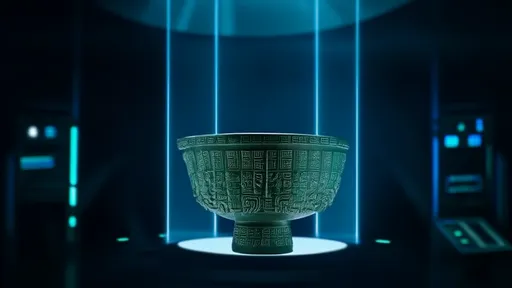
For centuries, archaeologists and historians have grappled with the frustrating reality that some of humanity's most valuable written records – bronze ritual vessel inscriptions from ancient China – lie trapped beneath layers of verdigris and mineral deposits. These corrosion layers, while preserving the bronzes themselves, often obscure the very texts that could shed light on early Chinese civilization. Now, a breakthrough imaging technique is allowing researchers to read inscriptions without physically removing the patina that protects these artifacts.
The technique, called neutron holography, represents a quantum leap in archaeological science. Unlike conventional X-rays which struggle to penetrate dense corrosion products, neutrons interact differently with matter, allowing them to pass through mineral layers while being scattered by the original metal surface. This produces a holographic image of the inscription as it existed when first cast, revealing characters that haven't been seen since the Western Zhou dynasty (1046–771 BCE).
How Neutron Holography Works
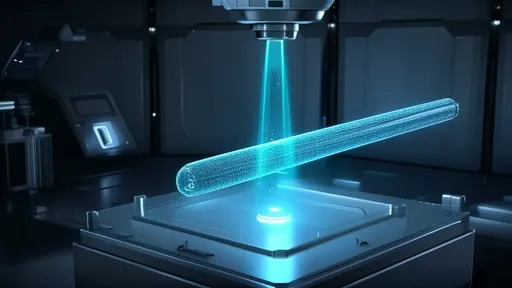
At the heart of this technology lies a nuclear reactor. Researchers place the bronze artifact in a neutron beam, where subatomic particles penetrate the object and interact with its atomic structure. The neutrons that scatter from the original inscribed surface interfere with those passing through unchanged, creating an interference pattern captured by detectors. Advanced algorithms then reconstruct this pattern into a three-dimensional map of the inscription's topography.
What makes this approach revolutionary is its non-destructive nature. Traditional methods of reading obscured inscriptions often required partial cleaning or even sectioning of artifacts, risking irreversible damage. Neutron holography preserves the artifact's integrity while revealing its secrets – a perfect marriage of conservation and discovery.
Decoding Lost Histories
The implications for Chinese historiography are profound. Recent scans of a heavily corroded you (wine vessel) in the Shanghai Museum collection revealed a previously unknown 48-character inscription documenting a royal land grant. Such records were the bureaucratic foundation of early Chinese states, but many have been lost to time. The newly revealed text mentions officials and locations that don't appear in any surviving records, forcing historians to reconsider the administrative geography of the period.
Equally exciting are the technological revelations. Some inscriptions show evidence of sophisticated character modification after casting – early "edits" to the bronze texts. This suggests a more dynamic process of inscription creation than previously assumed, with texts potentially being updated to reflect changing political circumstances.
Challenges and Future Directions
Despite its promise, the technique faces limitations. The requirement for a nuclear reactor means analysis can't be performed on-site at museums or dig locations. Additionally, the method works best on leaded bronzes, as the lead content enhances neutron contrast. Researchers are now developing portable neutron sources and refining algorithms to work with a wider range of bronze alloys.
Looking ahead, scientists anticipate applying neutron holography to other corrosion-obscured artifacts – from Roman lead curse tablets to medieval iron implements with maker's marks. Each successful application brings us closer to a new era in archaeology, where no information is considered truly lost to oxidation and time.
The marriage of nuclear physics and archaeology exemplifies how cutting-edge science can breathe new life into ancient mysteries. As more bronzes undergo neutron analysis, we stand on the brink of rewriting chapters of early Chinese history – all without removing a single molecule of protective patina.
By /Aug 14, 2025

By /Aug 14, 2025

By /Aug 14, 2025
By /Aug 14, 2025

By /Aug 14, 2025
By /Aug 14, 2025
By /Aug 14, 2025
By /Aug 14, 2025
By /Aug 14, 2025
By /Aug 14, 2025
By /Aug 14, 2025
By /Aug 14, 2025

By /Aug 14, 2025
By /Aug 14, 2025
By /Aug 14, 2025
By /Aug 14, 2025

By /Aug 14, 2025
By /Aug 14, 2025
By /Aug 14, 2025
By /Aug 14, 2025
