Deep beneath the Earth's surface, where cosmic interference fades into silence, scientists are hunting for one of the universe's most elusive phantoms—sterile neutrinos. These hypothetical particles, if they exist, could rewrite our understanding of particle physics and dark matter. Laboratories buried under mountains or nestled in abandoned mines have become the frontline in this decades-long pursuit, where researchers deploy ultra-sensitive detectors to catch the faintest whispers of these ghostly particles.
The concept of sterile neutrinos emerged as a tantalizing solution to several astrophysical anomalies. Unlike their more sociable cousins—electron, muon, and tau neutrinos—which interact via the weak nuclear force, sterile neutrinos would communicate only through gravity. This aloofness makes them nearly undetectable, yet their potential gravitational influence on galaxy rotations and cosmic structures keeps the hypothesis alive. Experiments like MiniBooNE at Fermilab and the upcoming JSNS² in Japan have reported tantalizing but inconclusive signals, fueling both excitement and skepticism.
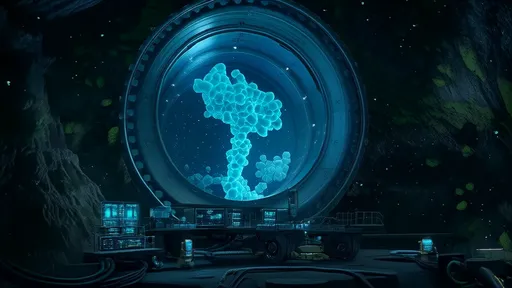
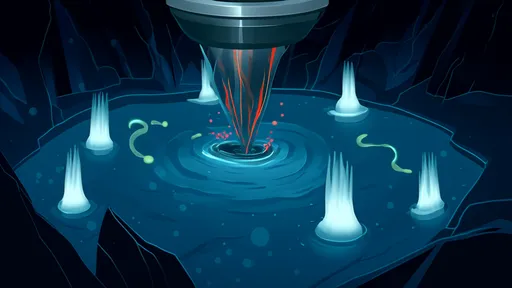
Underground laboratories play a pivotal role in this quest. Facilities such as Italy's Gran Sasso National Laboratory or South Dakota's Sanford Underground Research Facility shield detectors from the cacophony of cosmic rays that bombard the surface. Here, in darkness and isolation, detectors filled with liquid argon or ultrapure germanium wait patiently for the once-in-a-lifetime interaction that might betray a sterile neutrino's presence. The deeper the lab, the quieter the environment—and the higher the stakes.
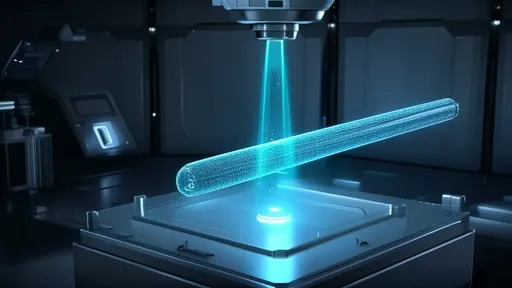
Recent technological leaps have sharpened the hunt. Quantum sensors now achieve sensitivities once thought impossible, while machine learning algorithms sift through petabytes of data to identify statistical aberrations that might hint at sterile neutrinos. Yet the field remains divided. Some argue that anomalies attributed to sterile neutrinos could stem from unaccounted-for background noise or flaws in detector calibration. Others point to the sterile neutrino's potential as a dark matter candidate as reason enough to persevere.
The implications of discovery would be profound. Sterile neutrinos could explain why the universe contains far more matter than antimatter, a disparity known as baryon asymmetry. They might also serve as the "missing" dark matter particle, though their suspected lightness makes them an unconventional fit. Even null results carry weight, as they force physicists to confront the limits of the Standard Model and consider more exotic theories.
As detectors grow more sophisticated and underground labs expand, the sterile neutrino remains the ultimate scientific ghost story—a specter that may or may not haunt the subatomic world. Whether these phantoms will materialize or fade into the annals of beautiful-but-wrong theories depends on the patience of those who listen in the dark. For now, the hunt continues, one delicate, imperceptible tremor at a time.

By /Aug 14, 2025

By /Aug 14, 2025

By /Aug 14, 2025
By /Aug 14, 2025

By /Aug 14, 2025

By /Aug 14, 2025
By /Aug 14, 2025

By /Aug 14, 2025
By /Aug 14, 2025
By /Aug 14, 2025

By /Aug 14, 2025
By /Aug 14, 2025

By /Aug 14, 2025

By /Aug 14, 2025
By /Aug 14, 2025

By /Aug 14, 2025

By /Aug 14, 2025

By /Aug 14, 2025

By /Aug 14, 2025

By /Aug 14, 2025
