The field of quantum computing has long been dominated by superconducting qubits and trapped ions, but a new contender is emerging—topological photonic chips. These devices harness the unique properties of topological photonics to create robust, error-resistant pathways for light, paving the way for scalable and fault-tolerant quantum computation. Unlike traditional photonic systems, which are highly sensitive to imperfections and environmental noise, topological photonic chips offer a promising solution by leveraging the inherent stability of topological states.
At the heart of this technology lies the concept of topological protection, a phenomenon borrowed from condensed matter physics. In topological photonics, light is guided along edges or interfaces in a way that is immune to backscattering and defects. This property is crucial for quantum computing, where even minor perturbations can disrupt fragile quantum states. By integrating these principles into chip-scale devices, researchers are now able to design optical circuits that maintain coherence over longer distances and timescales—a critical requirement for practical quantum information processing.
The Marriage of Topology and Photonics
The fusion of topology and photonics has given rise to a new class of materials known as photonic topological insulators. These materials exhibit exotic behaviors, such as unidirectional edge states that allow light to travel in one direction without being scattered. This is analogous to the quantum Hall effect in electronics but realized with photons instead of electrons. The ability to control light in such a precise manner opens up unprecedented opportunities for quantum computing, where information can be encoded in the quantum states of photons and processed with minimal loss or decoherence.
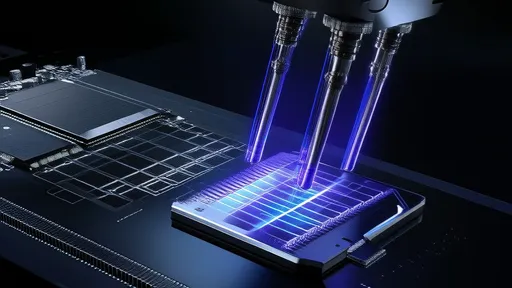
One of the most exciting developments in this area is the creation of integrated topological photonic circuits. These circuits combine multiple optical components—such as waveguides, resonators, and beam splitters—into a single chip, enabling complex quantum operations to be performed on a compact platform. The integration of these components is made possible by advanced nanofabrication techniques, which allow for the precise engineering of photonic structures at the nanometer scale. As a result, topological photonic chips are not only more robust but also more scalable than their conventional counterparts.
Quantum Computing on a Chip
The potential of topological photonic chips for quantum computing is immense. Photons, as carriers of quantum information, have several advantages over other qubit platforms. They interact weakly with their environment, reducing decoherence, and can be easily manipulated using standard optical components. Moreover, photons can travel long distances without significant loss, making them ideal for distributed quantum networks. By incorporating topological protection into photonic chips, researchers are addressing one of the biggest challenges in quantum computing: maintaining quantum coherence in the face of noise and errors.
Recent experiments have demonstrated the feasibility of using topological photonic chips for quantum information processing. For instance, entangled photon pairs—a key resource for quantum communication and computation—have been successfully generated and manipulated in these devices. The topological nature of the chips ensures that the entanglement is preserved even in the presence of fabrication imperfections or external disturbances. This robustness is a game-changer for the development of practical quantum technologies, as it significantly reduces the need for error correction and fault tolerance.
Challenges and Future Directions
Despite their promise, topological photonic chips are not without challenges. One of the main hurdles is the difficulty of achieving strong nonlinear interactions between photons, which are essential for certain quantum gates and operations. While linear optical quantum computing can perform many tasks, nonlinearities are required for universal quantum computation. Researchers are exploring various approaches to overcome this limitation, such as integrating nonlinear materials into the photonic circuits or coupling the chips to other quantum systems, like atoms or superconducting qubits.
Another area of active research is the scalability of topological photonic chips. While current devices can integrate dozens of components, scaling up to thousands or millions of components—necessary for large-scale quantum computing—remains a daunting task. Advances in fabrication techniques and the development of new topological materials will be crucial in addressing this issue. Additionally, the integration of topological photonic chips with classical electronic control systems poses its own set of challenges, requiring innovative solutions to ensure seamless operation.
The Road Ahead
The journey toward practical quantum computing is fraught with obstacles, but topological photonic chips offer a compelling path forward. Their unique combination of robustness, scalability, and compatibility with existing optical technologies makes them a strong candidate for the next generation of quantum hardware. As research in this field continues to advance, we can expect to see more breakthroughs that bring us closer to realizing the full potential of quantum computing.
In the coming years, collaborations between physicists, engineers, and material scientists will be key to overcoming the remaining challenges. By pushing the boundaries of what is possible with topological photonics, these efforts could ultimately lead to the creation of quantum computers that are not only powerful but also practical and accessible. The integration of topological photonic chips into the broader quantum computing ecosystem represents a significant step toward this goal, heralding a new era of innovation in quantum information science.

By /Aug 14, 2025

By /Aug 14, 2025

By /Aug 14, 2025

By /Aug 14, 2025

By /Aug 14, 2025

By /Aug 14, 2025

By /Aug 14, 2025

By /Aug 14, 2025
By /Aug 14, 2025
By /Aug 14, 2025

By /Aug 14, 2025

By /Aug 14, 2025

By /Aug 14, 2025
By /Aug 14, 2025

By /Aug 14, 2025

By /Aug 14, 2025
By /Aug 14, 2025

By /Aug 14, 2025

By /Aug 14, 2025

By /Aug 14, 2025
